The GPU that ate the world
A chip built to draw video games became the engine of AI. How the graphics card beat the CPU, and why Nvidia got there first.

This story is also becoming a short film for YouTube. Music only, sources on screen.
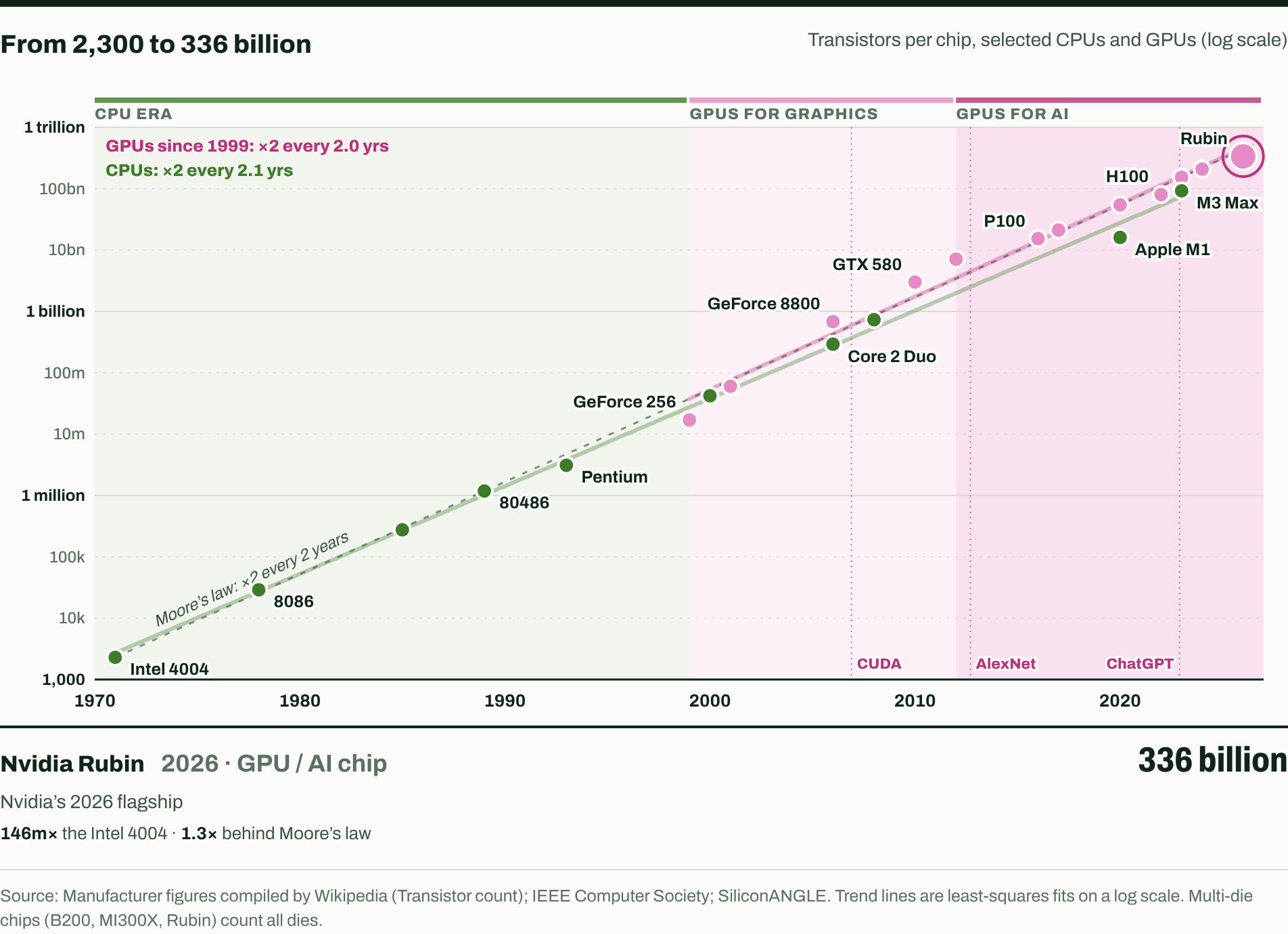
In 1999 Nvidia called its GeForce 256 the world’s first “GPU”. It had 17 million transistors and one job: draw triangles fast enough for games. In 2026 its Rubin GPU has 336 billion and runs the world’s AI.
The turn came in 2012, when two gaming cards trained AlexNet and crushed a famous image-recognition contest. The maths of neural networks turned out to be the same maths as graphics: huge grids of numbers multiplied at once.
Tap any underlined term for a plain-English explanation.
The story in one chart
Drag to slide, zoom, click any moment.- Milestone
- Turning point
- Drag to slide, scroll the strip to zoom, click a marker
How it works
A CPU is built to do a few things very quickly, one after another: a handful of powerful cores, big caches and clever prediction. A GPU is built to do thousands of simple things at once. Drawing a frame of a video game means shading millions of pixels in parallel.
Training and running a neural network turns out to be the same kind of job: enormous grids of numbers multiplied together. That accident of design is why the graphics chip, not the CPU, now powers AI.
The turning points
All 17 moments on the full timeline →- 01Oct 1999
“The world’s first GPU”
Nvidia markets the GeForce 256 as the first GPU: 17 million transistors on TSMC’s 220-nanometre process, with lighting and geometry handled on the chip.
17mtransistors - 02Nov 2006
CUDA
Nvidia announces CUDA alongside the GeForce 8800 (681 million transistors), letting scientists program GPUs in C. It becomes the moat around Nvidia’s business.
- 032012
AlexNet
Two GeForce GTX 580 gaming cards train the network that kicks off the deep-learning boom.
- 042022
H100
The 80-billion-transistor H100 becomes the most sought-after chip in the world as the AI race begins.
- 052026
Vera Rubin
Rubin: 336 billion transistors on TSMC’s 3-nanometre-class process, 288 GB of HBM4 memory and about 22 TB/s of memory bandwidth per GPU.
336bntransistors per GPU
The data
Free to republish with credit.Hover or tap a dot for the chip. Switch to Linear to see how sharp the AI-era climb really is.
Go deeper
- Wikipedia, Transistor count (compiled manufacturer figures)
- IEEE Computer Society, Nvidia’s GeForce 256
- Tom’s Hardware, The history of Nvidia GPUs
- SiliconANGLE, Nvidia debuts Rubin (Jan 2026)
- TweakTown, Vera Rubin at GTC 2026
Corrections: [email protected]. See how we check numbers.
More stories
All 19 stories → Film coming soonData story 03 · AI and computeSeventy years of AI: two winters and a gold rushArtificial intelligence got its name in 1956. It took two funding winters, a chess match and a pile of gaming chips to get to ChatGPT.
 Film coming soonData story 04 · AI and computeInference is the new gold rushTraining a model makes headlines. Running it, billions of times a day, is where the money and the electricity now go.
 Film · 8:10Data story 01 · Data centres and powerAustralia’s data centre and power boomAEMO now expects data centres to use seven times more electricity within a decade. Here’s where they’re going, who’s queuing to plug in, and who pays.