The rise of the GPU
How a chip built for video games became the engine of AI, and why the CPU lost its crown.
 Read the story · film coming soonThe GPU that ate the world→
- Milestone
- Turning point
- Drag to slide, scroll the strip to zoom, click a marker
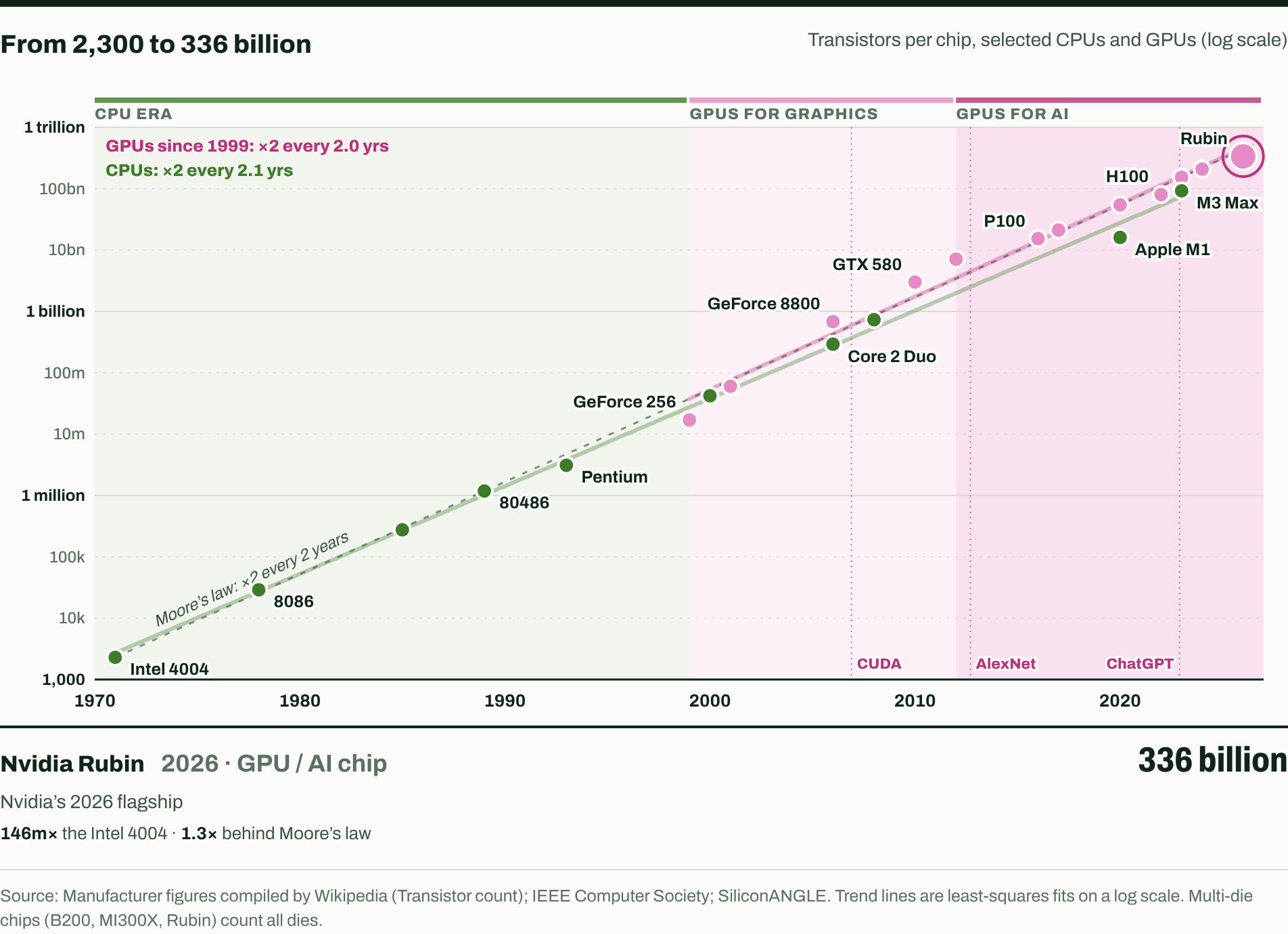
A CPU is built to do a few things very quickly, one after another: a handful of powerful cores, big caches and clever prediction. A GPU is built to do thousands of simple things at once. Drawing a frame of a video game means shading millions of pixels in parallel.
Training and running a neural network turns out to be the same kind of job: enormous grids of numbers multiplied together. That accident of design is why the graphics chip, not the CPU, now powers AI.
- 19711971
Intel 4004
The first commercial microprocessor: 2,300 transistors on a 10-micrometre process.
2,300transistors - 19781978
x86 begins
Intel’s 8086, with 29,000 transistors, starts the x86 family that still runs most PCs and servers.
- 19851985
32-bit
The Intel 80386 brings 32-bit computing to the PC with 275,000 transistors.
- 19931993
Pentium
Intel’s Pentium passes 3 million transistors.
- 1999Oct 1999
“The world’s first GPU”
Nvidia markets the GeForce 256 as the first GPU: 17 million transistors on TSMC’s 220-nanometre process, with lighting and geometry handled on the chip.
17mtransistors - 20012001
Programmable shaders
The GeForce3 lets developers write small programs that run on the GPU, the first step to general-purpose GPU computing.
- 20052005
The clock-speed wall
CPU clock speeds stall near 4 GHz because of heat. Chipmakers turn to multiple cores instead: parallelism becomes the only way forward.
- 2006Nov 2006
CUDA
Nvidia announces CUDA alongside the GeForce 8800 (681 million transistors), letting scientists program GPUs in C. It becomes the moat around Nvidia’s business.
- 20122012
AlexNet
Two GeForce GTX 580 gaming cards train the network that kicks off the deep-learning boom.
- 20152015–16
Google’s TPU
Google deploys its own Tensor Processing Unit, a chip built only for neural networks, and reveals it in 2016.
- 20162016
The first DGX
Nvidia hand-delivers its first DGX-1 AI server, built on the 15.3-billion-transistor P100, to OpenAI.
- 20172017
Tensor cores
The V100 (21.1 billion transistors) adds tensor cores: circuits dedicated to the matrix maths at the heart of AI.
- 20202020
A100 and Apple M1
Nvidia’s A100 reaches 54.2 billion transistors. Apple’s M1 shows CPU, GPU and AI engine on one chip with 16 billion.
- 20222022
H100
The 80-billion-transistor H100 becomes the most sought-after chip in the world as the AI race begins.
- 20232023
AMD’s challenge
AMD’s MI300X, built from chiplets with 153 billion transistors, targets AI with more memory per chip.
- 20242024
Blackwell
Nvidia’s B200 joins two dies into one GPU with 208 billion transistors. Racks of 72 GPUs act as one giant computer.
- 20262026
Vera Rubin
Rubin: 336 billion transistors on TSMC’s 3-nanometre-class process, 288 GB of HBM4 memory and about 22 TB/s of memory bandwidth per GPU.
336bntransistors per GPU
Hover or tap a dot for the chip. Switch to Linear to see how sharp the AI-era climb really is.
- Wikipedia, Transistor count (compiled manufacturer figures)
- IEEE Computer Society, Nvidia’s GeForce 256
- Tom’s Hardware, The history of Nvidia GPUs
- SiliconANGLE, Nvidia debuts Rubin (Jan 2026)
- TweakTown, Vera Rubin at GTC 2026
Dates for early events are widely documented; recent figures are labelled with their source, and forecasts are marked as forecasts.