The digital computer: a timeline
From room-sized machines of vacuum tubes to chips with hundreds of billions of transistors, including Australia’s own first computer.
 Read the story · film coming soonFrom ENIAC to your pocket: the digital computer→
- Milestone
- Turning point
- Australia
- Drag to slide, scroll the strip to zoom, click a marker
- 19361936
The universal machine
Alan Turing’s paper “On Computable Numbers” describes a theoretical machine that can carry out any calculation. It becomes the blueprint for computer science.
- 19411941
Zuse’s Z3
In Berlin, Konrad Zuse completes the Z3, a working programmable, fully automatic digital computer built from telephone relays.
- 19441944
Colossus
At Bletchley Park, Tommy Flowers’ Colossus uses vacuum tubes to help break German codes, a secret for decades afterwards.
- 1946Feb 1946
ENIAC is unveiled
The Electronic Numerical Integrator and Computer fills a large room in Philadelphia, with about 18,000 vacuum tubes and around 150 kW of power.
~18,000vacuum tubes
- 1947Dec 1947
The transistor
John Bardeen, Walter Brattain and William Shockley build the first transistor at Bell Labs. Every chip since is made of them.
- 1949Nov 1949Australia
CSIRAC: Australia’s first computer
CSIRAC runs its first program in Sydney, one of the world’s first stored-program computers. It later moved to Melbourne and is now in Melbourne Museum.
- 19511951
Computers go on sale
The Ferranti Mark 1 in Britain and the UNIVAC I in the US become the first commercially available computers.
- 19581958–59
The integrated circuit
Jack Kilby at Texas Instruments and Robert Noyce at Fairchild put multiple components on a single chip.
- 19641964
IBM System/360
IBM launches a family of compatible mainframes, so software can move between machines. It defines business computing for decades.
- 19651965
Moore’s law
Gordon Moore predicts the number of components on a chip will keep doubling at a regular pace. He later settles on every two years.
- 1969Oct 1969
ARPANET
The first message is sent across ARPANET, the network that grew into the internet.
- 1971Nov 1971
The microprocessor
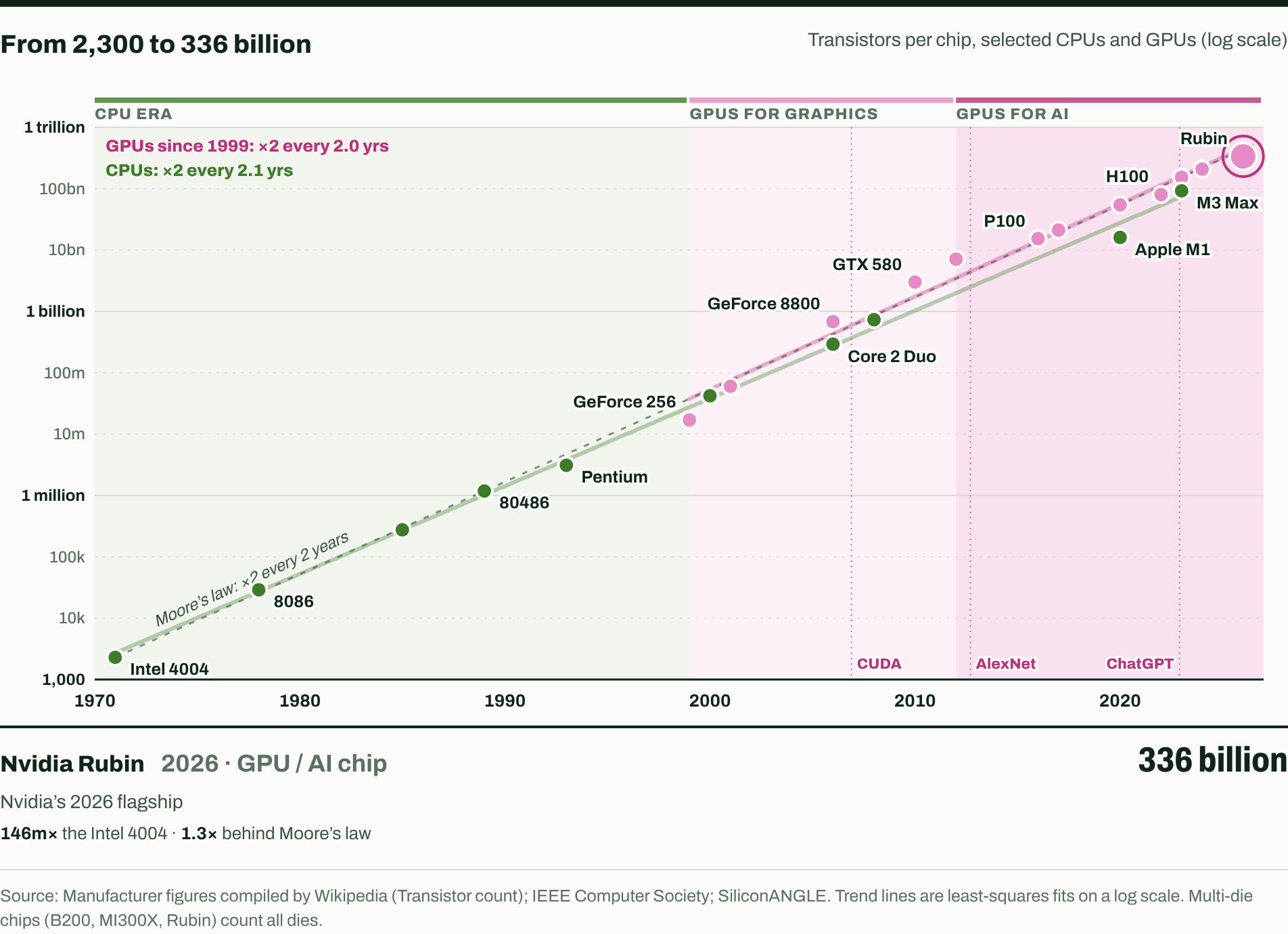
Intel’s 4004 puts a whole processor on one chip, with 2,300 transistors.
2,300transistors - 19771977
Personal computers
The Apple II, Commodore PET and TRS-80 bring computers into homes and schools.
- 1981Aug 1981
The IBM PC
IBM’s personal computer and Microsoft’s DOS set the standard the PC industry is built on.
- 1984Jan 1984
The Macintosh
Apple popularises the mouse and the graphical interface of windows and icons.
- 19911989–91
The World Wide Web
Tim Berners-Lee proposes the web at CERN in 1989; it opens to the public in 1991.
- 2007June 2007
The iPhone
The smartphone puts a powerful networked computer in billions of pockets.
- 2019Oct 2019
Quantum supremacy claim
Google says its Sycamore quantum processor completed a task that would take a classical supercomputer far longer. The claim is debated.
- 20222022
Exascale
The US Frontier supercomputer becomes the first to officially pass one exaflop: a billion billion calculations a second.
10¹⁸calculations a second - 20262026
336 billion transistors
Nvidia’s Rubin GPU packs 336 billion transistors across two dies, about 146 million times as many as the 4004.
146m×the transistors of the 4004 (our arithmetic)
Hover or tap a dot for the chip. Switch to Linear to see how sharp the AI-era climb really is.
- Turing machine (Wikipedia)
- CSIRAC (Wikipedia)
- History of computing hardware (Wikipedia)
- TOP500, June 2022: Frontier
- Nvidia Rubin: 336 billion transistors (SiliconANGLE, Jan 2026)
Dates for early events are widely documented; recent figures are labelled with their source, and forecasts are marked as forecasts.