Quantum computing: a timeline
Four decades from a physicist’s thought experiment to machines with more than a thousand qubits, and the long fight against errors.
 Read the story · film coming soonThe quantum race: counting the qubits that count→
- Milestone
- Turning point
- Australia
- Drag to slide, scroll the strip to zoom, click a marker
A normal bit is 0 or 1. A qubit can be in a mix of both, and qubits can be linked (entangled) so they behave as one system. For some problems, such as simulating molecules or breaking certain codes, that could be exponentially faster.
The catch is noise. Qubits lose their state at the slightest disturbance. Counting qubits is easy; making them reliable is hard. The real race is for logical qubits: groups of physical qubits that correct each other’s errors.
- 19811981
Feynman’s idea
Richard Feynman suggests that only a computer built on quantum mechanics could efficiently simulate nature.
- 19851985
A universal quantum computer
David Deutsch describes a quantum version of Turing’s universal machine.
- 19941994
Shor’s algorithm
Peter Shor shows a quantum computer could factor large numbers quickly, threatening the encryption that protects the internet.
- 19961996
Grover’s search
Lov Grover finds a quantum shortcut for searching unsorted data.
- 19981998
Two qubits
The first small quantum computers, using nuclear magnetic resonance, run simple algorithms with two qubits.
- 20012001
15 = 3 × 5
IBM researchers use a 7-qubit machine to run Shor’s algorithm and factor 15.
- 20112011
First commercial machine
D-Wave sells a quantum annealer, a specialised machine for optimisation problems.
- 20122012Australia
A qubit in silicon
A UNSW Sydney team shows a working qubit made from a single phosphorus atom in silicon.
- 2016May 2016
Quantum in the cloud
IBM puts a 5-qubit quantum processor online for anyone to use.
- 2019Oct 2019
Quantum supremacy claim
Google says its 53-qubit Sycamore did a task in minutes that would take a supercomputer far longer. Rivals dispute the margin.
- 20212021
Eagle: 127 qubits
IBM passes 100 qubits on one chip.
- 2023Dec 2023
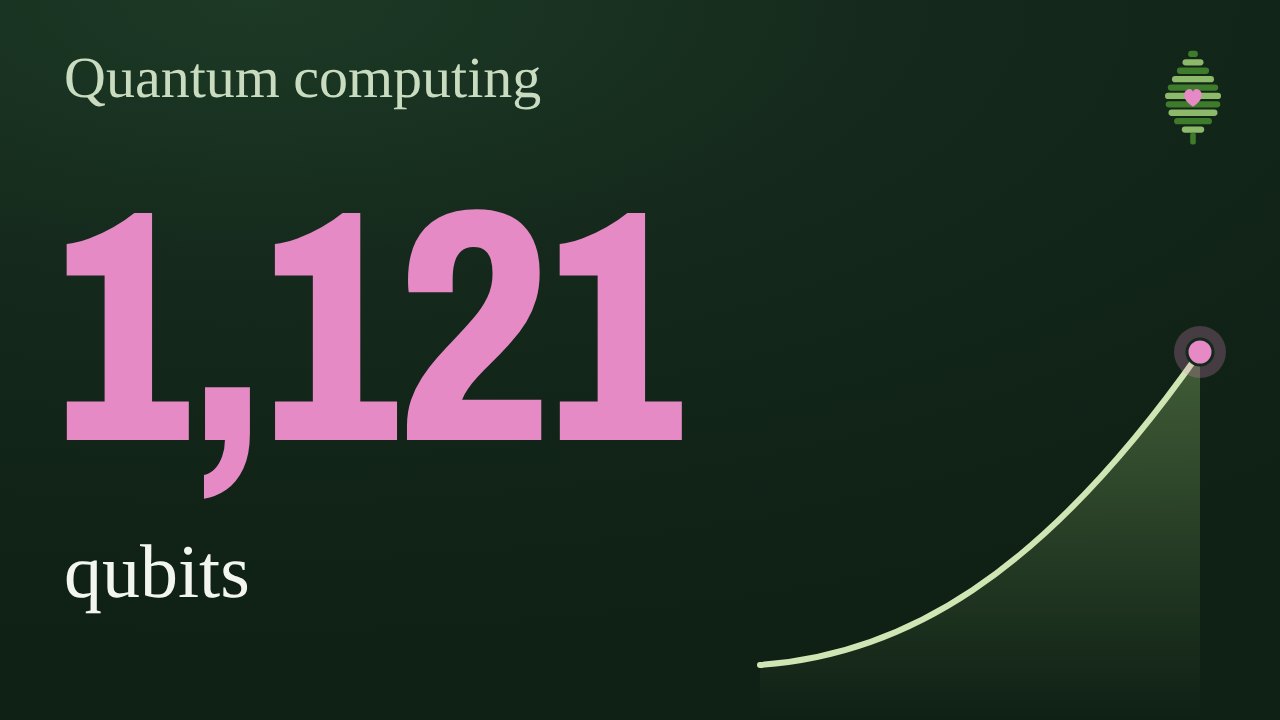
Condor: 1,121 qubits
IBM’s Condor passes a thousand qubits, but IBM shifts its focus to quality over quantity.
1,121qubits
- 2024April 2024Australia
Brisbane bet
The Australian and Queensland governments commit about A$940 million to PsiQuantum to build a quantum computer in Brisbane.
- 2024April 2024
Reliable logical qubits
Microsoft and Quantinuum combine 30 physical qubits into 4 logical qubits with error rates up to 800 times lower.
- 2024Dec 2024
Willow
Google’s 105-qubit Willow chip shows errors falling as more qubits are added to a logical qubit, a key threshold.
- 2026July 2026
70 logical qubits
IBM and the University of Chicago report a quantum-advantage demonstration using 70 logical qubits, finishing in about 15 minutes.
70logical qubits
- IBM and University of Chicago demonstrate quantum advantage (July 2026)
- Microsoft and Quantinuum, most reliable logical qubits on record (April 2024)
- Google Quantum AI’s quest for error-corrected quantum computers (arXiv)
- IEEE Spectrum, Next-level quantum computers (2026)
- Timeline of quantum computing (Wikipedia)
Dates for early events are widely documented; recent figures are labelled with their source, and forecasts are marked as forecasts.