From ENIAC to your pocket: the digital computer
The machines that filled rooms with vacuum tubes, the transistor that replaced them, and the chips that put a supercomputer in every pocket.
This story is also becoming a short film for YouTube. Music only, sources on screen.
The first electronic computers filled rooms, used thousands of vacuum tubes and broke down constantly. The transistor (1947), the integrated circuit (1958) and the microprocessor (1971) shrank them step by step.
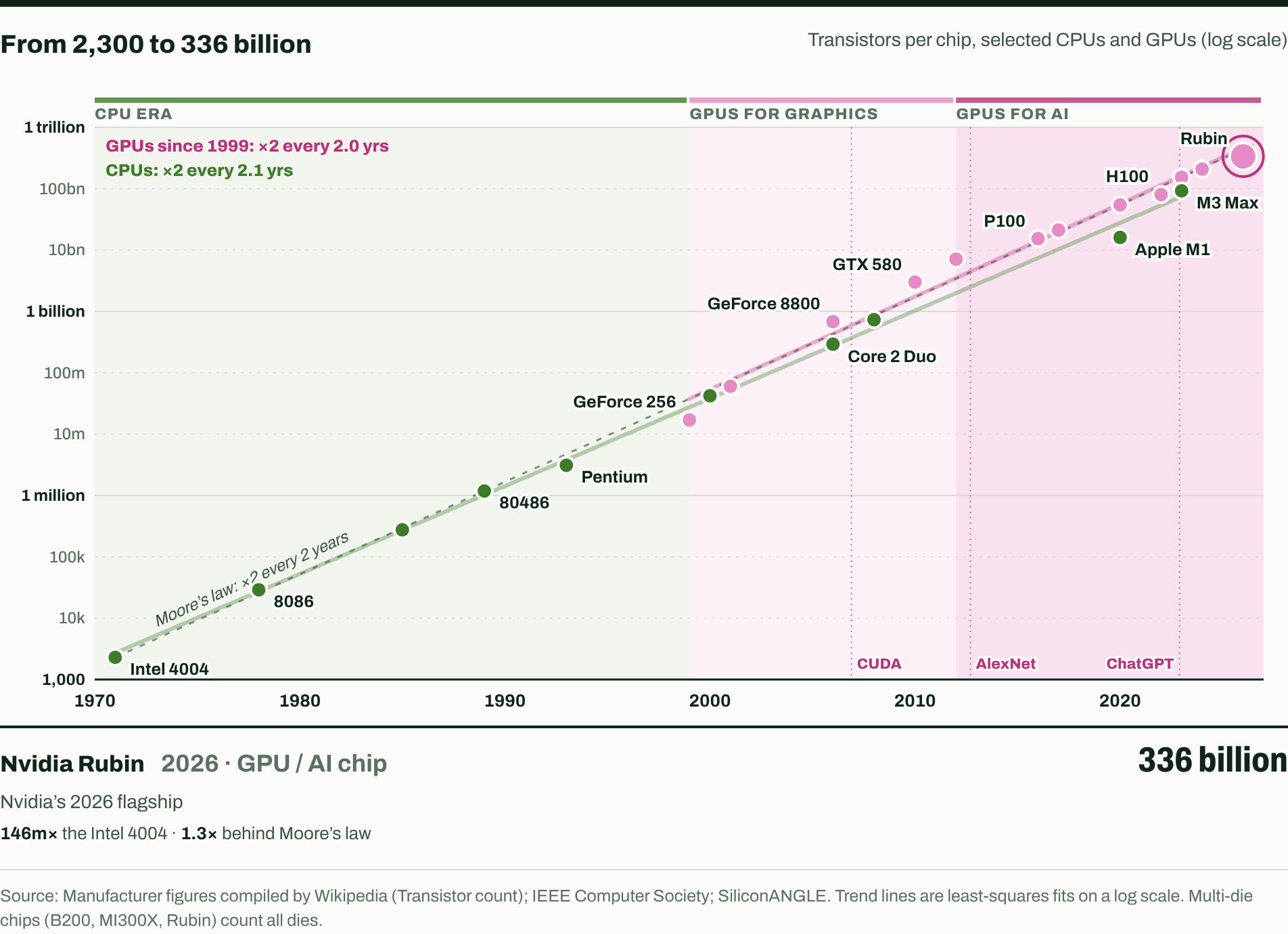
The Intel 4004 had 2,300 transistors. A single Nvidia Rubin GPU now has 336 billion. Along the way Australia built one of the world’s first stored-program computers, CSIRAC, in 1949.
Tap any underlined term for a plain-English explanation.
The story in one chart
Drag to slide, zoom, click any moment.- Milestone
- Turning point
- Australia
- Drag to slide, scroll the strip to zoom, click a marker
The turning points
All 20 moments on the full timeline →- 011936
The universal machine
Alan Turing’s paper “On Computable Numbers” describes a theoretical machine that can carry out any calculation. It becomes the blueprint for computer science.
- 02Feb 1946
ENIAC is unveiled
The Electronic Numerical Integrator and Computer fills a large room in Philadelphia, with about 18,000 vacuum tubes and around 150 kW of power.
~18,000vacuum tubes - 03Dec 1947
The transistor
John Bardeen, Walter Brattain and William Shockley build the first transistor at Bell Labs. Every chip since is made of them.
- 041965
Moore’s law
Gordon Moore predicts the number of components on a chip will keep doubling at a regular pace. He later settles on every two years.
- 05Nov 1971
The microprocessor
Intel’s 4004 puts a whole processor on one chip, with 2,300 transistors.
2,300transistors - 061989–91
The World Wide Web
Tim Berners-Lee proposes the web at CERN in 1989; it opens to the public in 1991.
- 07June 2007
The iPhone
The smartphone puts a powerful networked computer in billions of pockets.
- 082026
336 billion transistors
Nvidia’s Rubin GPU packs 336 billion transistors across two dies, about 146 million times as many as the 4004.
146m×the transistors of the 4004 (our arithmetic)
The data
Free to republish with credit.Hover or tap a dot for the chip. Switch to Linear to see how sharp the AI-era climb really is.
Go deeper
More stories
All 19 stories → Film coming soonData story 06 · Chips and hardwareIs Moore’s law finally over?Chipmakers kept Gordon Moore’s promise for six decades. Now the node names have stopped meaning anything, and the physics is fighting back.
 Film coming soonData story 07 · Chips and hardwareThe memory wall: AI’s hidden bottleneckProcessors got fast; memory didn’t keep up. The fix is a stack of chips welded beside the GPU, and only three companies can make it.
 Film coming soonData story 16 · Chips and hardwareWhere the world’s data livesTape, spinning disks and flash chips: how storage grew 12 million times in 70 years, and how AI is pushing it further.