Where the world’s data lives
Tape, spinning disks and flash chips: how storage grew 12 million times in 70 years, and how AI is pushing it further.
This story is also becoming a short film for YouTube. Music only, sources on screen.
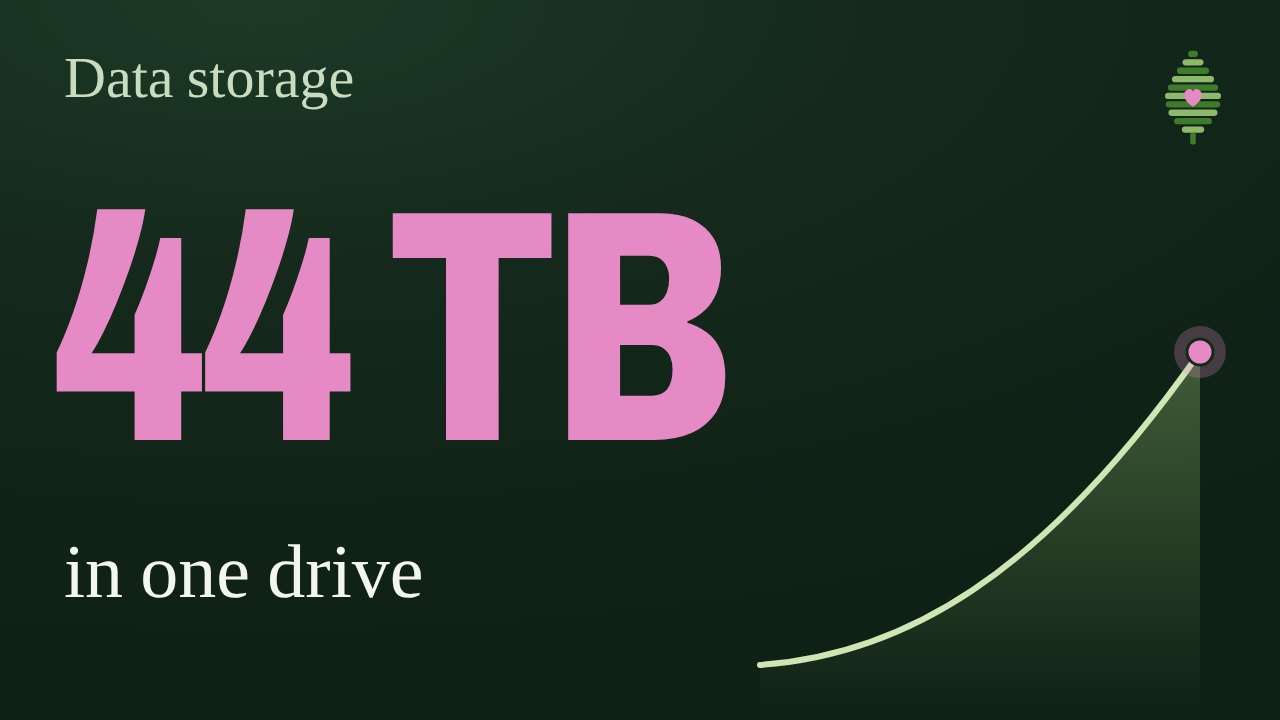
IBM’s first hard drive, in 1956, held 3.75 megabytes and weighed about a tonne. In 2026 a single drive holds 44 terabytes, about 12 million times more.
Spinning disks are still the cheapest way to store huge amounts of data; flash chips are faster and fill phones and AI servers. Drive makers now heat the disk with a laser as they write to reach 100 TB by the end of the decade.
Tap any underlined term for a plain-English explanation.
The story in one chart
Drag to slide, zoom, click any moment.- Milestone
- Turning point
- Drag to slide, scroll the strip to zoom, click a marker
How it works
Every photo, model and message has to live somewhere. Two technologies do most of the work: hard drives, which store data magnetically on spinning platters and are still the cheapest way to keep huge amounts, and flash, chips with no moving parts that are faster and now fill phones, laptops and AI servers.
The line shows the largest hard drive available, on a log scale. AI’s appetite for data is pushing both technologies harder: hard-drive makers are using lasers to heat the disk as they write (HAMR) to reach 100 TB by the end of the decade.
The turning points
All 13 moments on the full timeline →- 01Sept 1956
The first hard drive
IBM’s 350 RAMAC stores 3.75 MB on fifty 24-inch platters. It weighs about a tonne and is leased, not sold.
3.75 MB - 021984–87
Flash memory
At Toshiba, Fujio Masuoka invents flash memory, first NOR (1984) then NAND (1987), which stores data on chips with no moving parts.
- 03Aug 2013
3D NAND
Samsung stacks flash cells vertically in layers. Modern chips stack hundreds of layers, making large, cheap SSDs possible.
- 04Jan 2024
Heat-assisted recording
Seagate launches 30 TB drives on its Mozaic 3+ platform, using a tiny laser to heat each spot on the disk as it writes (HAMR).
- 05March 2026
44 TB
Seagate’s Mozaic 4+ HAMR drives reach 44 TB. Western Digital ships 40 TB drives and plans 100 TB HAMR drives by 2029.
Go deeper
- Seagate, Mozaic 4+ press release (March 2026)
- StorageReview, WD 40TB UltraSMR starts shipping (Aug 2026)
- Tom’s Hardware, WD plans 100TB HAMR drives by 2029
- IBM, the IBM 350 RAMAC disk file
- History of hard disk drives (Wikipedia)
Corrections: [email protected]. See how we check numbers.
More stories
All 19 stories → Film coming soonData story 06 · Chips and hardwareIs Moore’s law finally over?Chipmakers kept Gordon Moore’s promise for six decades. Now the node names have stopped meaning anything, and the physics is fighting back.
 Film coming soonData story 07 · Chips and hardwareThe memory wall: AI’s hidden bottleneckProcessors got fast; memory didn’t keep up. The fix is a stack of chips welded beside the GPU, and only three companies can make it.
 Film coming soonData story 08 · Chips and hardwareFrom ENIAC to your pocket: the digital computerThe machines that filled rooms with vacuum tubes, the transistor that replaced them, and the chips that put a supercomputer in every pocket.