Chips and hardware
Transistors, memory, storage and the machines they make.
Interactive timelines
All 18 timelines →Timeline · 1936 to nowThe digital computerFrom room-sized machines of vacuum tubes to chips with hundreds of billions of transistors, including Australia’s own first computer.20 moments · drag, zoom, click →Timeline · 1965 to now · TechnicalMoore’s law and chipmakingFrom 10 micrometres to “2 nanometres”: how the chip industry kept its promise to double for six decades, and why the names stopped meaning anything.13 moments · drag, zoom, click →Timeline · 1953 to now · TechnicalThe memory wall and HBMProcessors got fast; memory didn’t keep up. The fix that powers AI is a stack of memory chips welded beside the GPU: high-bandwidth memory.13 moments · drag, zoom, click →Timeline · 1951 to now · TechnicalData storageFrom a hard drive the size of two fridges holding 3.75 MB to a single drive holding 44 TB, and the flash chips that replaced spinning disks in your pocket.13 moments · drag, zoom, click →Timeline · 1949 to now · AustraliaAustralia’s computing storyOne of the world’s first computers, the invention inside Wi-Fi, a quantum bet in Brisbane and a data centre boom: Australia’s place in computing history.16 moments · drag, zoom, click →
Stories
 Film coming soonData story 06 · Chips and hardwareIs Moore’s law finally over?Chipmakers kept Gordon Moore’s promise for six decades. Now the node names have stopped meaning anything, and the physics is fighting back.
 Film coming soonData story 07 · Chips and hardwareThe memory wall: AI’s hidden bottleneckProcessors got fast; memory didn’t keep up. The fix is a stack of chips welded beside the GPU, and only three companies can make it.
 Film coming soonData story 08 · Chips and hardwareFrom ENIAC to your pocket: the digital computerThe machines that filled rooms with vacuum tubes, the transistor that replaced them, and the chips that put a supercomputer in every pocket.
 Film coming soonData story 16 · Chips and hardwareWhere the world’s data livesTape, spinning disks and flash chips: how storage grew 12 million times in 70 years, and how AI is pushing it further.
 Film coming soonData story 19 · Chips and hardwareAustralia’s computing storyCSIRAC in 1949, a wireless breakthrough that ended up in billions of devices, a quantum bet in Brisbane and a data centre boom.
Charts on this topic
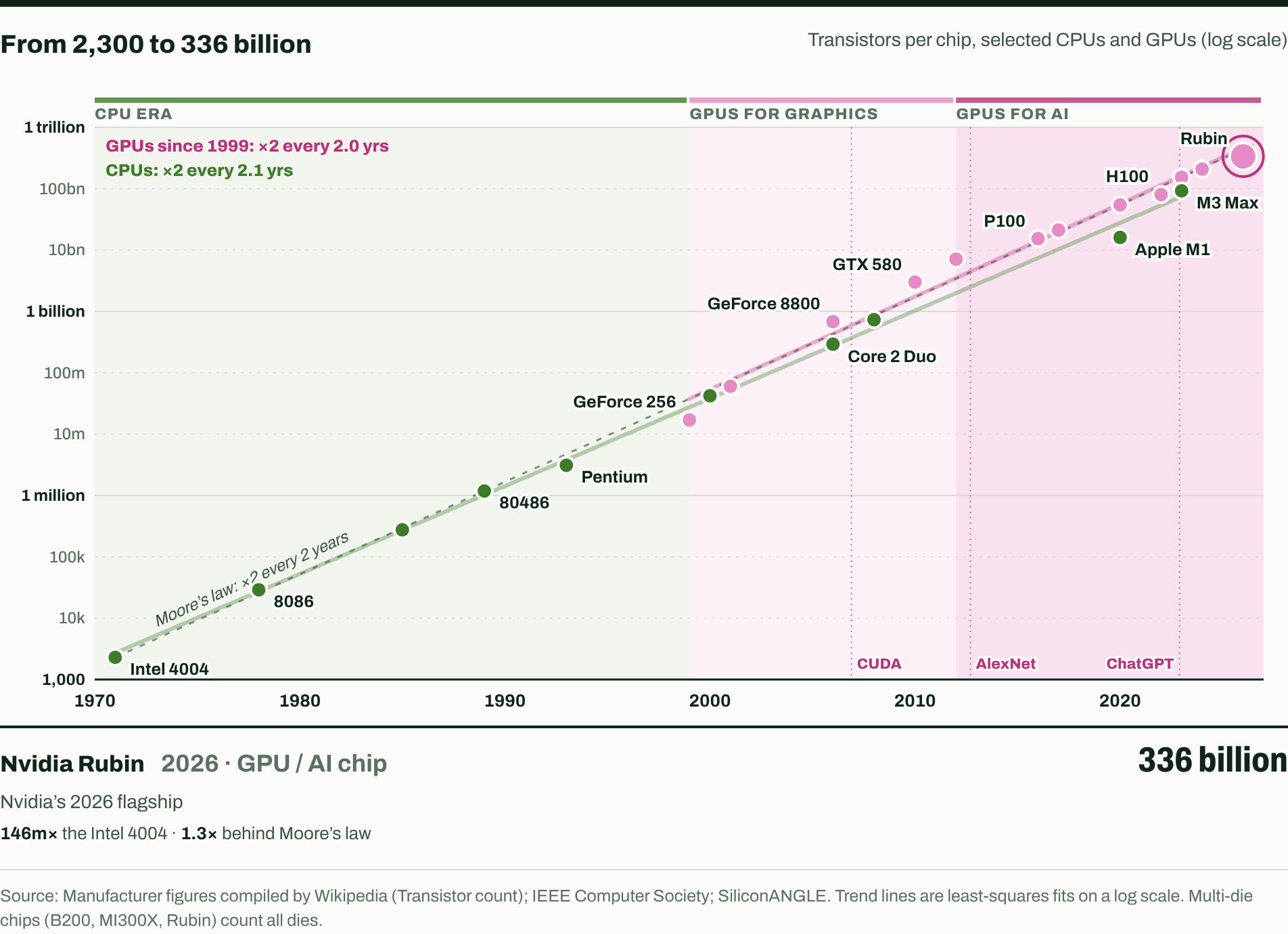
All charts →From 2,300 to 336 billionTransistors per chip, selected CPUs and GPUs (log scale)
Hover or tap a dot for the chip. Switch to Linear to see how sharp the AI-era climb really is.